Making Waves With Corin Millais: 39 Years Indoors, Fighting for the Outdoors
Making Waves is our monthly spotlight on clients in the UNLESS community doing impactful work worth knowing about. This month, Corin Millais, who spent 39 years campaigning for renewable energy and ethical banking, and then retired with clarity and reassurance at 61 to spend time in his vegetable garden reflecting on new ways to have impact.
Nearly everything worth doing pays out later than you can comfortably wait. That is true of a super balance, a career, a house, and a campaign to change an entire industry. Picking the right thing is rarely the hard part.
The hard part is the years and decades in the middle, when nothing visible is happening, the evidence for your position looks thin, and most of the people who started alongside you have moved on to something that pays off this quarter. If you have ever wondered whether that kind of patience returns anything, and whether it creates change worth the wait, Corin Millais’ career of four decades is living proof of it.
Patient commitment is also the way we think about impact investing at UNLESS. Capital pointed at something better does not reward you by the end of the week. It compounds, slowly, meaningfully, in the direction you intentionally aimed it.
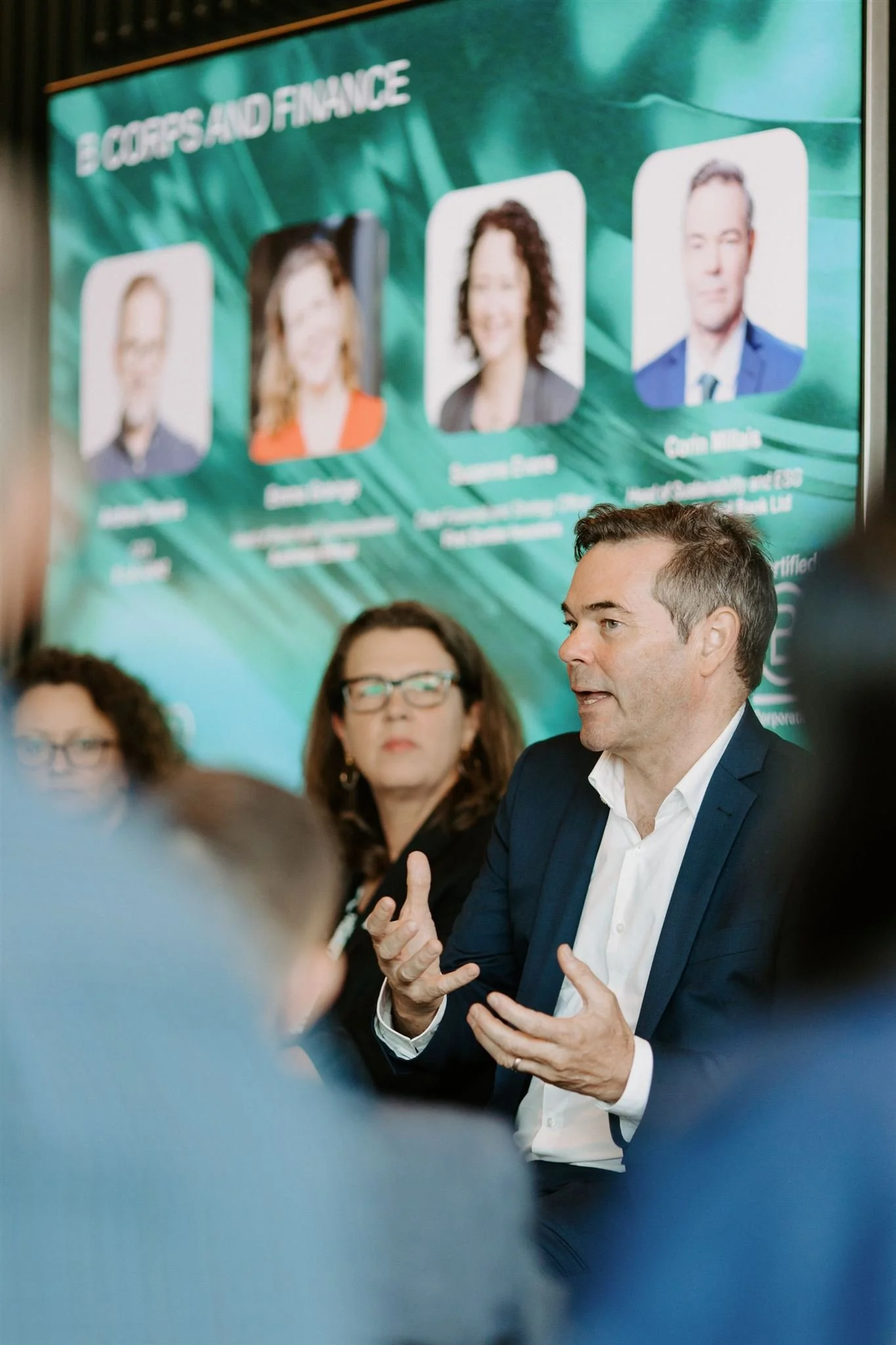
Pictured: Corin Millais
Conviction before consensus
"Big changes take decades so advocacy is a marathon event," says Corin.
From 1990 to 2002 Corin was at Greenpeace, campaigning on climate and the ozone layer. He also ran something unusual for the organisation at the time, its pro-business campaigns. The best known is Greenfreeze. In 1992, after chemical companies accused Greenpeace of attacking CFCs without offering a replacement, it put engineers in a room, designed a fridge that ran on natural hydrocarbons, found a struggling East German manufacturer willing to build it, and collected around 70,000 pre-orders for a product that did not exist. The first unit came off the line in 1993 and roughly a billion of those fridges are now in use.
In 2002 Corin moved to Brussels as chief executive of the European Wind Energy Association, now WindEurope and founded the global body, Global Wind Energy Council (GWED). That same year the Association published a business blueprint called Wind Force 12, arguing that wind could supply 12 per cent of the world's electricity by 2020, and that no technical, economic or resource barrier stood in the way. That scenario was laughed at by the energy establishment, but ended up becoming the reality.
He came to Australia in 2006 to run the Climate Institute, the independent think tank behind the Climate of the Nation survey that tracked what the country actually thought about all this, and spent a stretch running the local arm of the carbon offset startup Climate Care. Then he crossed over into corporate sustainability jobs at Westfield and Mirvac, and finally to Teachers Mutual Bank, where he spent fifteen years running their sustainability and ESG strategy until he retired last year.
"I feel fortunate to be paid a wage in a field that I loved and has meaning," is how he accounts for his values-driven career.
Inside the B Corporation movement
While he was at Teachers Mutual Bank, the bank became a certified B Corp. Getting to certification, Corin says, "took a few hard years to attain." He goes further than the certificate, saying of the bank, "we topped Bank Australia's score, who are hands down the #1 ethical bank." The bank also was the only Australian bank named as a Responsible Investment Association Australasia (RIAA) Responsible Investment Leader each year from 2021 to 2024.
His enthusiasm is for the movement rather than the badge itself. "B Corp companies are amazing, innovative capitalists who create a new economy," he says. He now sits on the B Council, a governance body set up by B Lab Australia and Aotearoa New Zealand, who represent around 800 B Corps employing around 45,000 people. And speaking of B Corps, UNLESS certified as a B Corp in early 2026, and he calls that "a huge deal", rating the level of measurement and quality as "the gold standard of ESG and bloody hard to attain". However being a B Corp was not what sold him on choosing to partner with us for financial advice, stating that “financial strength is as crucial as ethical strength. After all, no one works in sustainability to get rich.”
Impact does not stop when your working career does
"No gravestone says I wish I'd been to more meetings," he says.
The Australian Bureau of Statistics puts the average age of people who retired during 2024-25 at 63.8, and the average age Australians over 45 intend to retire at 65.6, a figure that keeps climbing. Corin was able to purposefully retire at 61, on a plan he trusted, with his superannuation savings invested ethically and in line with his values.
Retiring earlier than average usually has less to do with earning more than with knowing, in some detail, what you have, what you need, and how long it must last.
Retiring also does not end your part in where money goes, which is the part most Australians write off. The balance you spent a working life accumulating carries on being lent, invested and voted somewhere for another twenty or thirty years, in your name, whether or not you look at it. You stop turning up to work, but your capital does not.
Why UNLESS
Corin met Dave Rae years ago in the industry, and by his account they later worked together on one of the technical working groups at the Australian Sustainable Finance Initiative (ASFI), whose 2020 roadmap put 37 recommendations to the Australian finance sector. "What struck me was he (Dave) never once pitched his services to me, a sign of integrity.
"Financial planning and strategic advice is complex, full of shonky operators, and despite working in fin services, its not easy to work this out yourself." So he approached Dave for guidance two years ago.
“Dave’s advice has literally been life changing; he showed our family it was possible to retire, and we enacted an intentional 2 year plan for me to finish full-time work, with scenarios of what the next 20-30 years looked like. Thanks to Dave I spent my first month as a retiree watching the World Cup.”
What’s next
Corin is frank about what his long values-driven career actually looked like. "It's a paradox that we all work in sustainability but this is in offices; you are not in nature, the very thing we all care about. There is still plenty of wilderness in the world to explore."
Now he can spend twelve hours in the vegetable garden, or happily take on the menial tasks in his wife's ceramics studio. "Immediately this is all about visceral experiences - outdoors in the bush, at the beach, in the garden, doing manual work, seeing live bands," he says.
None of which means he has stopped having an impact. He plans to get involved in local charities and volunteering, possibly take on board roles, and is finishing writing a book. "Retiring hopefully rewires my brain to tackle those challenges better," he says.
Corin spent four decades passionately working for a more just, safe, fairer, sustainable world outside from inside an office. Now at 61, he is mostly outdoors, and his passion for the environment carries on throughout his days and the investments his super is invested in – which is why he is able to retire with clarity and peace of mind. Dave says he is "glad to have played a decisive role in his impact journey and retirement planning."