Making Waves With Rob Chan: How Your Idle Car Can Earn Its Keep
Making Waves is our monthly spotlight on clients in the UNLESS community doing impactful work worth knowing about. First up, the man running the world's largest car-sharing marketplace in Australia, Rob Chan.
Ask Rob how you shift a country onto cleaner transport and he won’t start with policy, subsidies or a protest placard. He’ll tell you about an ordinary person trying an electric car for the first time and after a few days, realising how enjoyable and easy it was to drive - with many of the assumptions and stigma around EVs falling away in the process.
Rob runs Turo in Australia, the local arm of the world's largest car-sharing marketplace, and his whole theory of change fits in a single sentence: "The goal isn't to sell people on sustainability; it's to make the sustainable choice the easy one."
He has spent most of his working life inside the businesses that move people. Five years at PwC consulting with Transport departments, four at Uber across Sydney and San Francisco, then a stretch at the e-bike company Zoomo, before joining Turo in 2023 and becoming Managing Director in 2025. He is also a dad to a 5 year-old, which “makes the whole 'liveable planet' thing feel a lot less abstract".
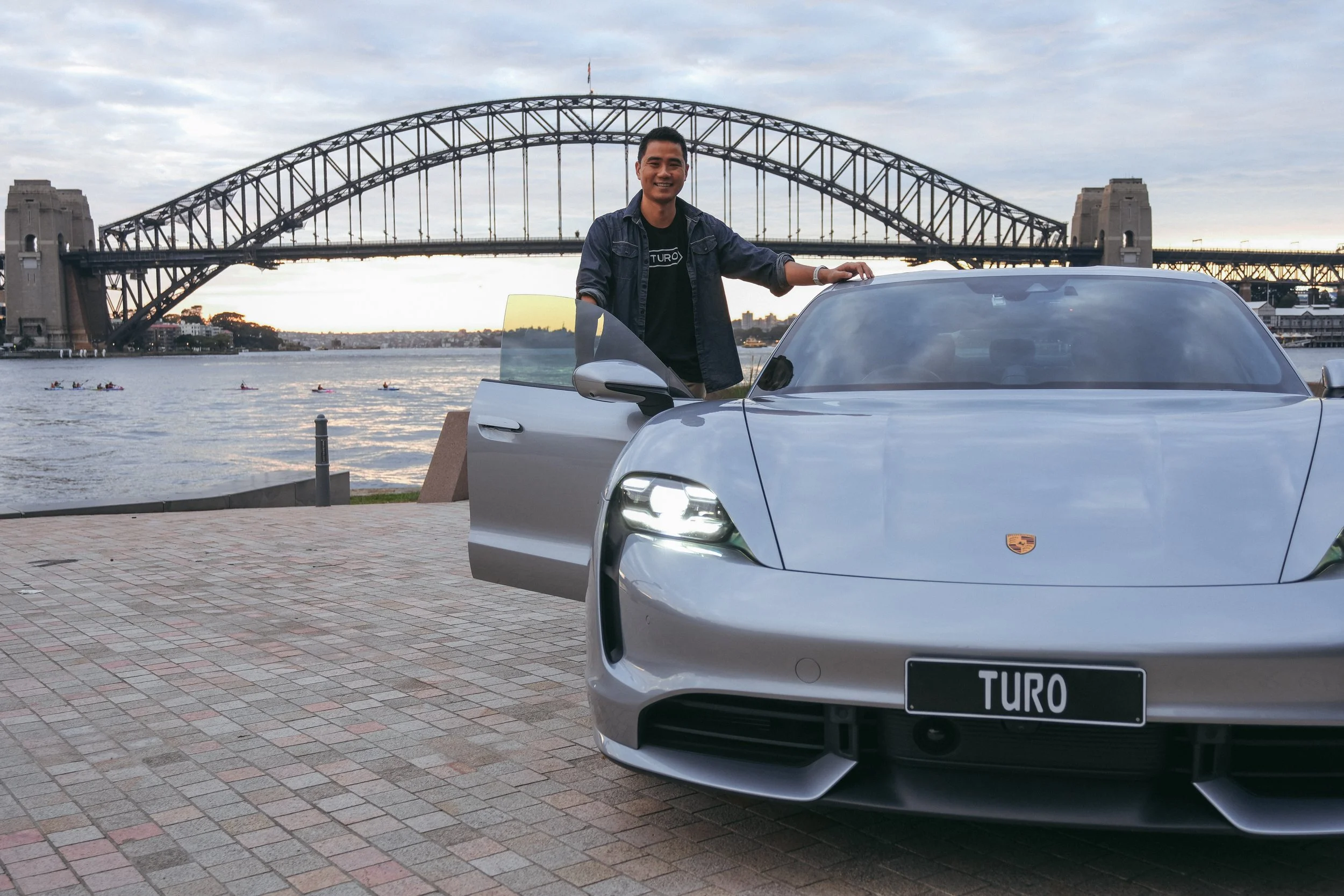
Pictured: Rob Chan
The idea
Turo turns what Rob calls a household's second most expensive asset into an earning machine. You list the car sitting idle in your driveway, someone else rents it, and a depreciating lump of metal starts paying for itself. Hosts earning real dollars and achieving independence is one of the most satisfying parts of the job. He’s seen families come together to build a small fleet, professionals leaving unsatisfying corporate jobs to work on their own time, or individuals using the earnings to fund travel or a wedding. All on the back of cars they already owned.
"The community I care about most is Turo hosts," he says, "Everyday people and small operators who've built real income and independence by sharing vehicles they already own."
What sets him apart is where he goes looking for change. "Most climate conversations happen at the level of politics, policy, and infrastructure," he says. "I'm more interested in the behaviour and social change layer: how do we build societal momentum, cross the chasm and make climate-positive choices the default one?" At Turo, that means making shared, electric transport the easiest and most obvious pick rather than the virtuous one. "To scale, we need the economics to work and a social moment that makes trying something new feel natural," he says. "That's the crossover I'm chasing."
The evidence
The numbers suggest he’s reading the country correctly. Turo Australia logged a +388 per cent year-on-year jump in electric-vehicle bookings early this year, a figure Rob puts down to drivers reacting to fuel prices rather than any sudden conversion to the cause. The wider market tells the same story with battery electric vehicles hitting 16.4 per cent of new car sales in April and a record 20.6 per cent in May, and the Tesla Model Y becoming the first electric vehicle to top Australia's monthly sales charts, outselling the Ranger and the Hilux.
"We've been operating here (Australia) for almost four years," he says. "In the US, our biggest market, it's been nearly seventeen." Australians love road trips and own cars at some of the highest rates on earth, so the growth journey for Turo is long. The next challenge is reaching more people and showing them what we do.
The wider ripple effect
Rob spreads himself across the edges of the problem, and most of that work involves getting people who would not otherwise meet into the same room. He hosts meetups for three communities. Everything Marketplaces brings together operators, investors and founders of multi-sided marketplace businesses, the people solving the same cold-start problem he faces at Turo. Lenny's Newsletter covers product, growth and career in tech.
The third is one with his industry. Mobility and Electrons is a breakfast series at Sydney's Greenhouse Climate Tech Hub, sitting at the intersection of electrification and mobility, and it pulls EV advocates, fleet operators, policymakers and climate communicators around one table. He has published an industry map of the sector alongside it. "The conversations are electric…" he says. And we love the pun.
If you’re an early bird and based in Sydney, the next event is in the morning of September 10: Mobility + Electrons Industry Breakfast. “Think of it as a “supercharger” stop for your workday,” he says.
Outside work, he backs five organisations, each one working to lower a barrier.
Parents for Climate works on "closing the gap between the many parents who are concerned about climate change and those who are active on it". Six mothers across four states and territories started it in 2019, and it now has more than 26,000 supporters with local groups in every state. Its flagship campaign, Solar Our Schools, pushes for rooftop solar and batteries on schools and early learning centres, and has helped secure more than $70 million in school solar funding across New South Wales, Tasmania and Western Australia.
The Australian Youth Climate Coalition is the country's largest youth-run climate organisation, with Rob noting that "history shouldn't be written for young people, but by them". It was founded in 2006 by Anna Rose and Amanda McKenzie, who now runs the Climate Council, and its work is mostly training young people to organise, through school workshops, local volunteer groups, meetings with MPs and a People of Colour Climate Network.
Groundswell Giving connects everyday donors with experts deploying climate solutions, which he sums up as "smarter giving". It answers a question most people give up on: where does a modest donation actually go the furthest? Australia's first climate-focused giving circle, it pools small regular contributions from members, runs grant applications past a panel of advisors for due diligence, then lets members vote on where the money lands. Around 750 members have granted more than $7 million to over 140 climate organisations, among them Solar Citizens, which campaigned for the federal home battery rebate, and the Environment Centre NT.
The Multicultural Leadership Initiative, because "diversity is a strategic necessity". His reasoning is that "people are culturally diverse; the social mandate for climate action needs to reflect that". It is a small, founder-led charity set up by climate and human rights advocate Rathana Chea, working to move culturally and linguistically diverse people into climate leadership roles through research, training and a climate ambassadors programme.
Build a Ballot is a non-partisan tool for voting with confidence, built on a diagnosis that matches everything else he does. "People aren't disengaged from democracy; they just need better tools." You answer a questionnaire on the issues you care about, and it scores every candidate and party standing in your electorate against your answers, then builds you a how-to-vote plan to take to the booth. More than 600,000 Australians used it at the 2025 federal election. It is run by the climate literacy charity Project Planet and takes no money from any party, candidate or campaign group.
LinkedIn is where he is easiest to find. He posts regularly on his work, the meetups he convenes, and whatever has caught his eye where transport, climate and human behaviour cross over and every so often, it’s the funniest thing his kid has said about the family EV.
Why UNLESS
For someone as deliberate about where his work and money are directed as Rob, finding the right financial adviser mattered. "When you spend your days building at work rooted in purpose and positive impact, the last thing you want is for the wealth you're building to quietly do the opposite in the background."
He wasn't looking for an adviser who would simply accommodate his values. As Rob puts it: "I was looking for a financial adviser who understood that the two aren't separate. Not someone who'd accommodate my values as an edge case, but someone where that alignment is just the baseline."
That led him to UNLESS Financial and Justin Medcalf, a Certified Responsible Investment Adviser with nearly two decades of experience in ethical and responsible investment.